case study
How did one small apothecary move from farmers market sales to a licensed production space?
A close look at the sequence one shop followed: home kitchen limits, a shared commercial space, facility registration, a written batch system, and the first wholesale account that paid for the lease.
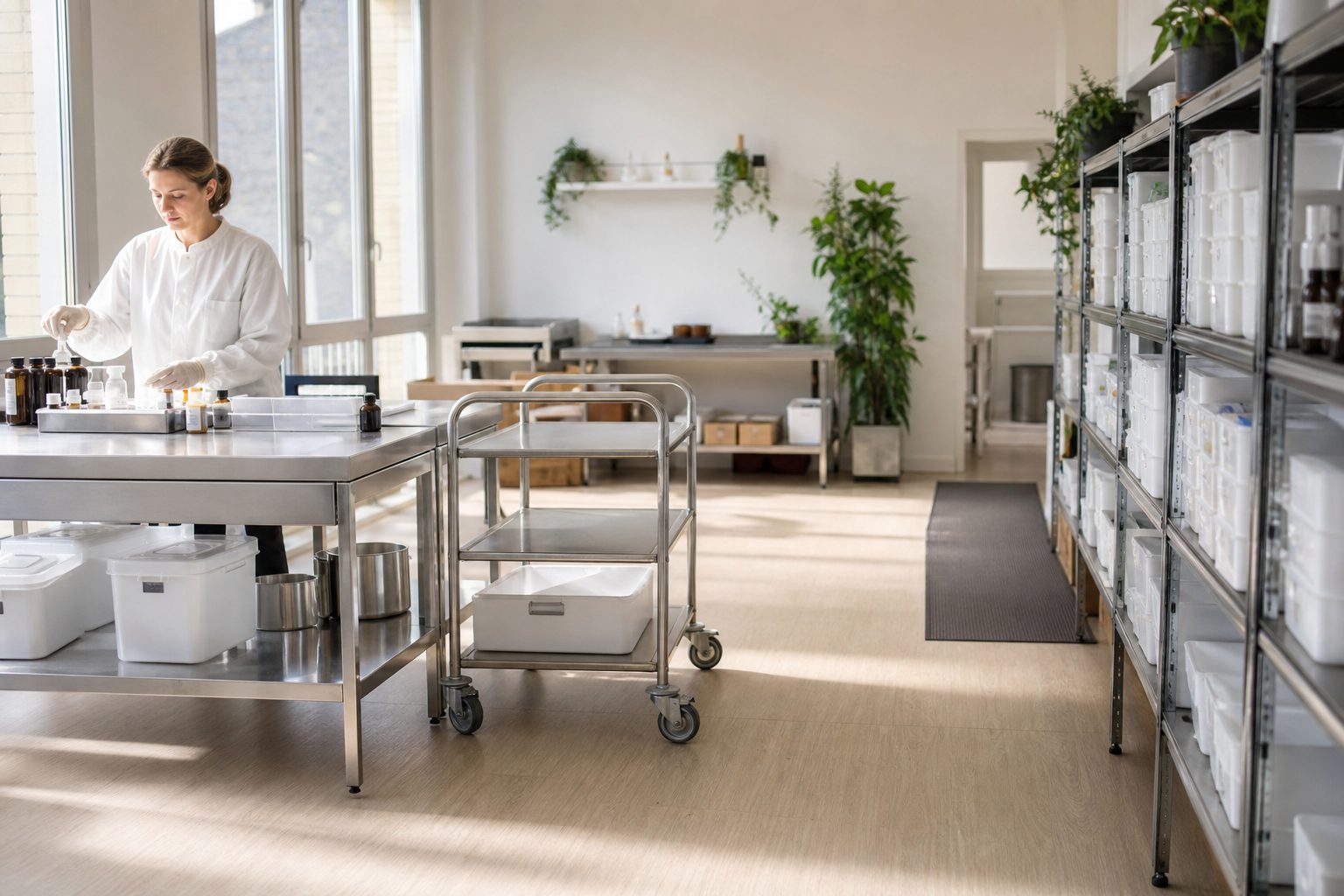
They did it in four moves over roughly three years, and none of the moves were the one most people expect. They did not lease a space and then figure out the compliance. They registered the facility, wrote the procedures, proved the throughput in a rented commercial kitchen, and signed a lease only when a wholesale account existed that would cover most of the rent.
This is a composite account drawn from the pattern that repeats in shops making this transition, described here as one shop's sequence because that is how the decisions actually arrive. Names and exact figures are not the point. The order is.
The single most useful thing in the story is the moment the owner understood that what she was making was never cottage food, and that no amount of good practice in a home kitchen was going to make it legal to sell a tincture at scale.
Where cottage food rules stop and supplement manufacturing begins
Cottage food laws are state laws, and they exist to let people sell low risk foods made at home: baked goods, jams, dry mixes, some candies. Every state's list is different, and every state's list is a list of foods.
A tincture is not on any of them. Neither is an encapsulated formula, nor a glycerite sold with a Supplement Facts panel. Once a product is a dietary supplement, it falls under federal manufacturing rules at 21 CFR Part 111, and a home kitchen is not a facility those rules contemplate. Herbal teas can sit in a genuinely grey area depending on the state and on the claims, which is part of why the line is easy to miss.
The shop in this account sold dried tea blends and salves at market for two years and told herself the tinctures were an extension of the same business. They were not. The moment the tinctures moved from client specific preparations made in a consultation practice to product sold off a table, she was a supplement manufacturer with no facility.
The practical trigger to watch for is not volume. It is whether you are making product ahead of a named client, holding it, and offering it for sale.
Keep reading: What should be on my checklist before I release a finished batch of salve to the shelf?
The shared kitchen year and what it taught about throughput
The intermediate step was a shared commercial kitchen with a supplement friendly landlord, rented in blocks. Roughly two eight hour blocks a month at first, at a rate in the range of $25 to $30 an hour, so something like $400 to $500 a month.
The year taught things a spreadsheet does not.
Setup and teardown consumed close to two hours of every eight hour block. Wheeling in bins, sanitizing surfaces, wheeling everything back out. That is a quarter of the paid time producing nothing, and it is the number that eventually justified a dedicated space more than any other.
Maceration does not fit a rented block. You cannot leave twelve carboys of steeping herb in a shared kitchen for two weeks. She solved it by macerating in sealed vessels stored offsite and using kitchen time only for pressing, filtering and bottling, which meant transport, which meant spills and a written transport procedure.
The throughput number that came out of it: a two person crew in a good block could press, filter and bottle roughly 400 to 500 one ounce bottles. At two blocks a month, about 1,000 bottles a month was the ceiling. That ceiling, priced out, was what told her whether a lease was affordable.
Facility registration and the paperwork before the lease
The order here matters and it is counterintuitive. Facilities that manufacture, process, pack or hold food, including dietary supplements, for consumption in the United States must register with the FDA, and registration renews in even numbered years. Registration is free and it is done online.
What tripped her up was the address. Registration is tied to a physical facility, so the registration follows the space. Signing a lease first and discovering afterward that the space cannot be brought into acceptable condition is the expensive version of this sequence.
What she assembled before signing anything:
- Business entity and EIN, with the entity name matching what would appear on labels.
- Confirmation from the local zoning office that light manufacturing was permitted at the address, in writing.
- Local and state health or food processing licensing requirements, which vary widely and are often the slower approval than the federal one.
- A written water source answer, because a facility on a private well has testing obligations a municipal connection does not.
- A floor plan showing separation between raw material storage, production, packaging and finished goods.
The zoning letter took six weeks. That is the item that most often stretches a timeline, and it costs nothing to start early.
Writing standard procedures for a two person operation
She wrote nine procedures, not ninety. A two person shop that writes a manual it cannot follow has written a liability, because the record then shows deviation from your own stated process.
The nine, each two pages or less:
- Receiving and quarantine of incoming ingredient lots.
- Ingredient identity verification and lot record creation.
- Cleaning and sanitation, with the schedule and the log.
- Equipment use and calibration, particularly scales.
- Master formula creation and version control.
- Batch production recording.
- Label review and approval before printing.
- Finished product release, hold and retained samples.
- Complaints, deviations and recall procedure.
The one that saved the most trouble was label review. Every label went through a two signature check against the batch record before it was printed, and that caught a net contents error on a run of 300 bottles that would otherwise have been a misbranding problem and a full reprint.
Keep reading: Where is the herbal products business heading now that state practice laws keep shifting?
The equipment list that mattered and the purchases that did not
Worth the money, in order of return:
- A calibrated bench scale with a printout, and a second smaller scale for herbs used in gram quantities. Calibration weights, checked and logged weekly.
- A hydraulic press. Manual pressing was the single biggest cost in labor hours and the biggest source of yield variation between batches.
- Enclosed food grade storage bins with lids and label holders, enough to hold every ingredient off the floor.
- A plate filter, once volume passed a few hundred bottles a month.
- A semi automatic filler. Hand filling one ounce bottles is where a production day disappears.
Bought too early and regretted: a stainless jacketed tank sized for batches she did not yet sell, a labeling machine bought before label artwork had settled and reprints were still frequent, and a walk in cooler for material that stored perfectly well in a cool dark room.
The rule she landed on: buy equipment that removes a labor hour you are currently paying for, and wait on equipment that anticipates volume you have not sold.
Insurance, product liability and the first wholesale contract
General liability does not cover product liability, and product liability for ingestible herbal products is a specialist line. Not every broker writes it. Expect underwriting questions about ingredients, claims made on labels, contract manufacturing, and whether you have written batch records. The last one is not decoration: a shop that cannot demonstrate traceability is a harder risk to place and prices accordingly.
The first wholesale account, a regional grocery with four stores, required the things wholesale buyers routinely require:
- A certificate of insurance naming the retailer as additional insured, with a stated per occurrence limit.
- Proof of facility registration.
- UPC codes, purchased through the official issuing body rather than resold single codes.
- Compliant Supplement Facts panels with the correct format, and no disease claims anywhere on the label or the shelf talker.
- A recall procedure with a named contact.
The order was about 600 units a month at wholesale. Against a lease in the range of $1,400 a month for a small production suite, that contribution was what made the lease a decision rather than a gamble.
See how HerbalCounter handles this for herbal apothecaries and small batch wellness makers
What the move did to cost per bottle
Here is the arithmetic she ran, using her own numbers. Treat the figures as illustrative of the shape, not as benchmarks.
| Line, per one ounce bottle | Shared kitchen | Own space |
|---|---|---|
| Herbs and menstruum | $2.10 | $1.75 |
| Bottle, dropper, label | $1.05 | $0.85 |
| Direct labor | $2.40 | $1.30 |
| Facility, allocated | $0.50 | $1.40 |
| Transport and setup time | $0.60 | $0.00 |
| Total | $6.65 | $5.30 |
Two things drive it. Labor falls because setup, teardown and transport vanish and because the press and filler replace hand work. Materials fall because a dedicated space can hold 25 pound purchases and 12 gross bottle orders. Facility cost rises sharply and is fixed, which is the whole risk: at 1,000 bottles a month the $1,400 lease is $1.40 a bottle, and at 400 bottles a month it is $3.50 and the move loses money.
That is the real decision rule. Divide your fixed facility cost by your honest monthly unit volume, not your hoped for volume, and see whether the number still clears the labor and materials savings.
What they would sequence differently
Three things, in her words.
Start the zoning conversation a year early, because it is free and it is the item with the longest and least controllable lead time.
Build the batch record system in the shared kitchen year, not after the move. She spent the first three months in the new space reconstructing lot histories from invoices and memory, which is exactly the work that a system in place would have made unnecessary, and exactly the work an insurer and a wholesale buyer will eventually ask to see.
Sign the wholesale account before the lease, not after. She very nearly did it the other way and would have carried five months of rent against farmers market revenue.
The record that makes the move possible
Every gate in this sequence, the insurance underwriter, the wholesale buyer, the facility inspector, asks the same underlying question: can you show which lots went into which batch, and which bottles that batch became. Answer it easily and the moves get cheaper.
HerbalCounter is built for exactly that record: ingredient lots with supplier and receiving detail, batch logs tied to the formulas they fill, client records tied to the batches they were dispensed from, and reorder prompts on the ingredients you cannot run out of. Start it in the shared kitchen year, and the licensed space inherits a system instead of a box of invoices.

Jimenez Julien builds HerbalCounter and spends part of every month behind a working counter with clinical herbalists and apothecary owners, watching how formula cards, batch books and lot tags are actually kept. He writes The Formulation Bench to put the costing, labeling and traceability questions that come up at the bench into plain, usable language.