checklist
What should be on my checklist before I release a finished batch of salve to the shelf?
A release step catches problems while they are still yours. The identity, weight, appearance, label and record checks to clear before a batch of salve leaves the bench for the retail shelf.
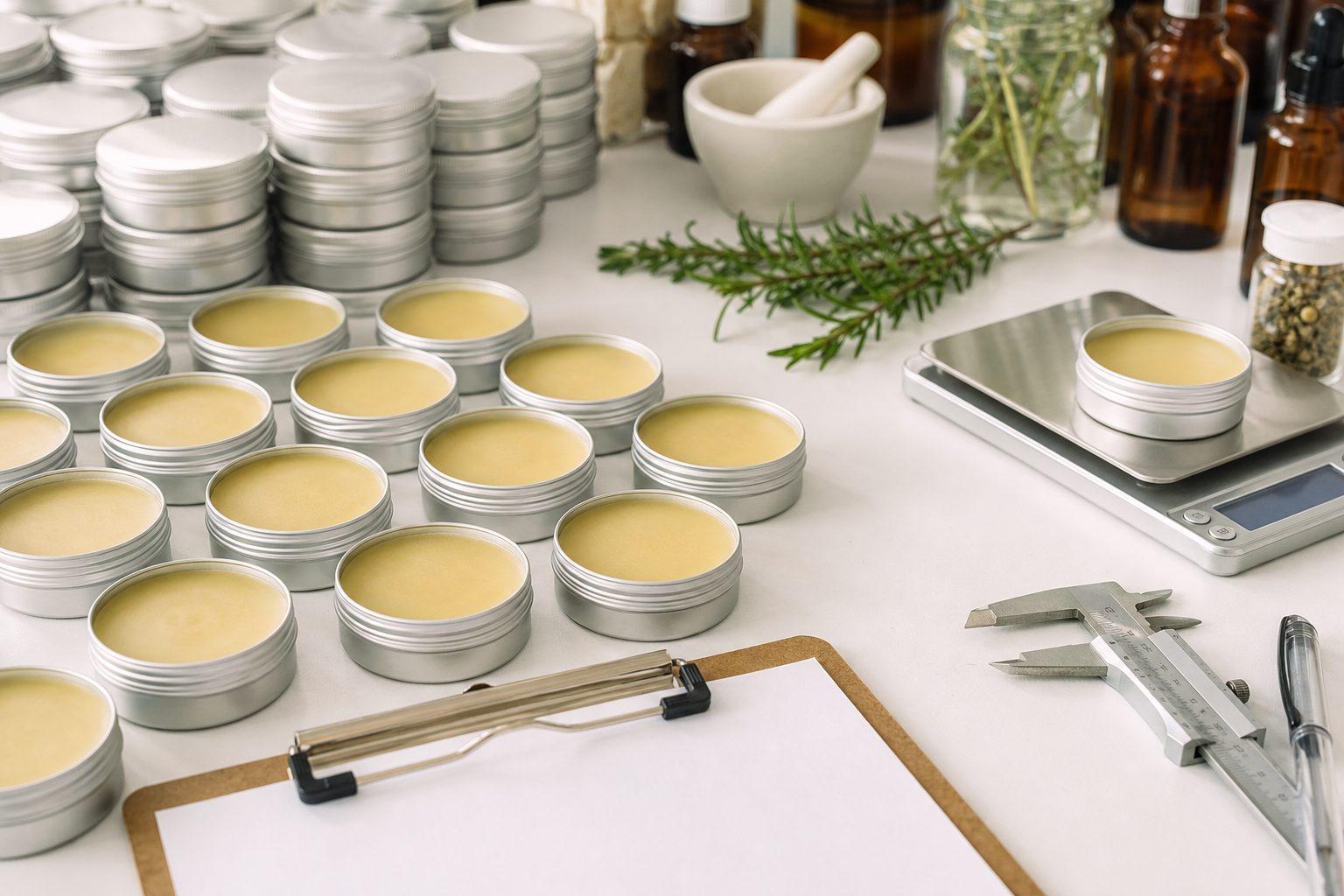
Before a batch of salve goes to the shelf, you want eight things cleared in one sitting: ingredient identity and lot numbers matched to the batch record, actual fill weight and container count reconciled against theoretical yield, appearance and texture judged after a full cure rather than while it is still warm, the printed label proofed against approved artwork with the correct lot code, a best by date you can justify in writing, a retention sample pulled and stored, and a dated signature from whoever holds release authority. The eighth thing is a written plan for what happens when one of those checks fails.
This is not a formality. A release step is the last moment a problem belongs to you alone. After release, the same problem belongs to a customer, possibly to a retailer who bought wholesale, and possibly to a state agriculture or health inspector asking how you knew what was in the tin. Fifteen minutes at the bench is cheap compared with a recall you have to reconstruct from memory.
Cosmetic products in the United States now sit under MoCRA, the Modernization of Cosmetics Regulation Act of 2022, which added facility registration, product listing and adverse event recordkeeping obligations for cosmetics. A salve marketed for dry skin is a cosmetic. The moment it carries a claim about healing, pain or a condition, it is being marketed as a drug, and a different and much heavier body of rules applies. Your release check is where you catch that drift before it prints.
Confirming ingredient identity and lot numbers against the record
Start at the raw material, not the finished tin. Open the batch record and read each line item against the physical containers still on the bench or in the cabinet. You are checking three things per ingredient: that the botanical is the species you specified, that the supplier lot on the jar matches the lot written in the record, and that the material was within its own use by window on the compounding date.
Species matters more than common name. Calendula officinalis and Tagetes are both sold as marigold. If your record says only "marigold infused oil, lot 4471," you cannot answer a question about what the customer actually put on their skin.
What a usable ingredient line looks like
- Botanical name with the part used: Calendula officinalis, flower
- Form: dried, in olive oil infusion at a stated ratio
- Supplier and supplier lot number, copied from the container, not from the invoice
- Your internal lot for the infused oil, if you made it
- Quantity used, in grams, and the person who weighed it
Keep reading: Where is the herbal products business heading now that state practice laws keep shifting?
Verifying fill weight and container count against theoretical yield
Theoretical yield is the sum of your input weights minus what you expect to lose. Actual yield is what ended up in tins. The gap between the two is the most reliable early warning you have.
Work a real example. Say a batch is 1,000 g of infused olive oil, 130 g of beeswax and 20 g of vitamin E oil. Total input is 1,150 g. You expect to lose roughly 4 percent to the pot, the strainer and the pour spout. That is an assumption drawn from your own past pours, and you should write it as one, not treat it as a constant.
| Line | Value |
|---|---|
| Total input weight | 1,150 g |
| Assumed process loss at 4 percent | 46 g |
| Expected available product | 1,104 g |
| Target fill per 2 oz tin | 56 g |
| Theoretical container count | 19 tins, with residue |
Now weigh five tins from across the pour, first, middle and last, on a scale that reads to 0.1 g. If your five average 54.2 g and you filled 19 tins, actual product is roughly 1,030 g. That is 74 g short of expectation, about 6.7 percent of the batch, not the 4 percent you assumed. Something is off: more residue in the pot than usual, a scale drifting, or a mis-weighed input.
Set a tolerance band before you start so the decision is not made in the moment. A practical rule: within 3 percent of expected yield, release. Between 3 and 8 percent, investigate and write down the cause before releasing. Beyond 8 percent, hold the batch and rebuild the arithmetic from the weigh sheet.
Underfill has a second consequence. Net contents on the label is a declaration. If the tin says 2 oz, which is 56.7 g, and your tins average 54.2 g, you are shipping short weight. Fix the fill or fix the declaration.
Appearance, texture and separation checks after full cure
Judge a salve cold and settled, not warm. Give it a full cure at room temperature, at least 24 hours, before you look at it critically. Anhydrous salves set slowly and a tin that looks perfect at hour two can pull away from the wall by morning.
Look for a sunken center, which usually means it was poured too hot. Look for grain, that sandy set beeswax and shea give you if the cool down was uneven. Look for a bead of liquid oil on the surface, which is separation and is a formulation problem, not a cosmetic one.
Keep one tin from a batch you were happy with as a physical reference standard, dated and set aside. Comparing against a real previous batch beats comparing against a description in a notebook.
Label proof against approved artwork and the correct lot code
Proof a label that is already applied to a tin, under the lamp you actually use, not the PDF on screen. Read it out loud against your approved artwork file.
- Product identity on the principal display panel
- Net quantity of contents in both ounces and grams
- Ingredient declaration in descending order of predominance, using INCI names for cosmetics
- Name and place of business of the responsible party
- A domestic contact for adverse event reports, as MoCRA requires on cosmetic labels
- Any warning statements your formulation calls for
- Lot code, matching the batch record exactly
The lot code is the check people skip and the one that matters most. A tin with the wrong lot printed on it cannot be traced, which means a recall becomes every tin you ever sold rather than nineteen. Read the code on the tin, then read the code in the record, then confirm they match character for character.
This is also the moment to catch a claim that crept in. "Soothing balm for dry skin" is cosmetic language. "Relieves eczema" is a drug claim and changes your entire regulatory position.
Keep reading: What is it really like to run a retail apothecary and a clinical practice out of one room?
Expiration or best by date and how you justified it
Cosmetics generally are not required to carry an expiration date, but if you print one you should be able to explain it. Write the reasoning into the batch record in one or two sentences.
For an anhydrous salve, the limiting factor is usually rancidity of the carrier oil rather than microbial growth, because there is no free water to support it. A sensible justification chain: the olive oil supplier states a best by date roughly 18 months from their pressing, the infusion was made three months ago, so the finished salve gets a 12 month best by from the fill date. That is conservative, it is traceable, and it is defensible.
Stability data strengthens it. Set two tins aside from each new formulation and check them at three, six and twelve months for odor, color and texture. After a few cycles you have your own evidence rather than a guess.
Retention sample pulled and stored
Pull one sealed, labeled tin from every batch and store it. Do not sell it, do not gift it, do not use it as a tester.
Store them in the dark at stable room temperature, grouped by year, and keep them for the best by period plus a buffer, so a 12 month salve gets an 18 month retention. When someone calls in month nine about a tin that smells wrong, you open your retention from that lot and find out in ninety seconds whether the problem is the batch or the customer's bathroom windowsill.
See how HerbalCounter handles this for herbal apothecaries and small batch wellness makers
Signature, date and who has authority to release
Name one person per batch. Release authority is a role, not a vibe, and in a two person shop it still needs to be written down.
The release line should carry the lot number, the date, the printed name and the signature, and a single sentence confirming every prior check passed. If an assistant compounded and packed, the release signature still belongs to the person accountable for the product. Write the delegation rule once, keep it where new staff can read it, and do not let a batch move to the retail shelf without ink.
Handling a batch that fails one check
The failure path needs to exist before you need it. Otherwise a tired maker at 7 p.m. decides that 54 g is close enough.
- Quarantine physically. Move the tins to a shelf that is not the sales shelf, with a tag naming the lot and the failed check.
- Record the deviation in the batch record while it is fresh: what was expected, what was observed, what you suspect.
- Decide the disposition and write which one you chose: release with a documented explanation, rework, downgrade to internal testers, or destroy.
- Note the corrective action for next time, such as recalibrating the scale or lowering the pour temperature by ten degrees.
- Close the record with a second signature.
Rework is legitimate for a salve that grained, since remelting and repouring is usually recoverable. Rework is not legitimate when you cannot confirm ingredient identity, because no amount of remelting fixes an unknown input.
Making the checklist survive a busy week
A release checklist works when it is attached to the batch, not to your intentions. The shops that hold the line keep the record and the tins together and refuse to separate them until the signature is there.
That is easier when the ingredient lots, the batch log and the finished product record are one linked chain rather than three notebooks. HerbalCounter ties each batch to the ingredient lots that went into it and to the client formulas it fills, so a lot number on a tin walks straight back to the supplier jar, and a release step becomes a screen you clear rather than paperwork you promise yourself you will reconstruct on Sunday.

Jimenez Julien builds HerbalCounter and spends part of every month behind a working counter with clinical herbalists and apothecary owners, watching how formula cards, batch books and lot tags are actually kept. He writes The Formulation Bench to put the costing, labeling and traceability questions that come up at the bench into plain, usable language.