numbers and benchmarks
How should I price a custom tincture formula when every client blend uses a different ingredient set?
Custom blends break flat pricing. Here is how to build a per formula price from menstruum cost, herb cost per gram, bottle and label, consult time and a batch overhead line that actually covers the bench.
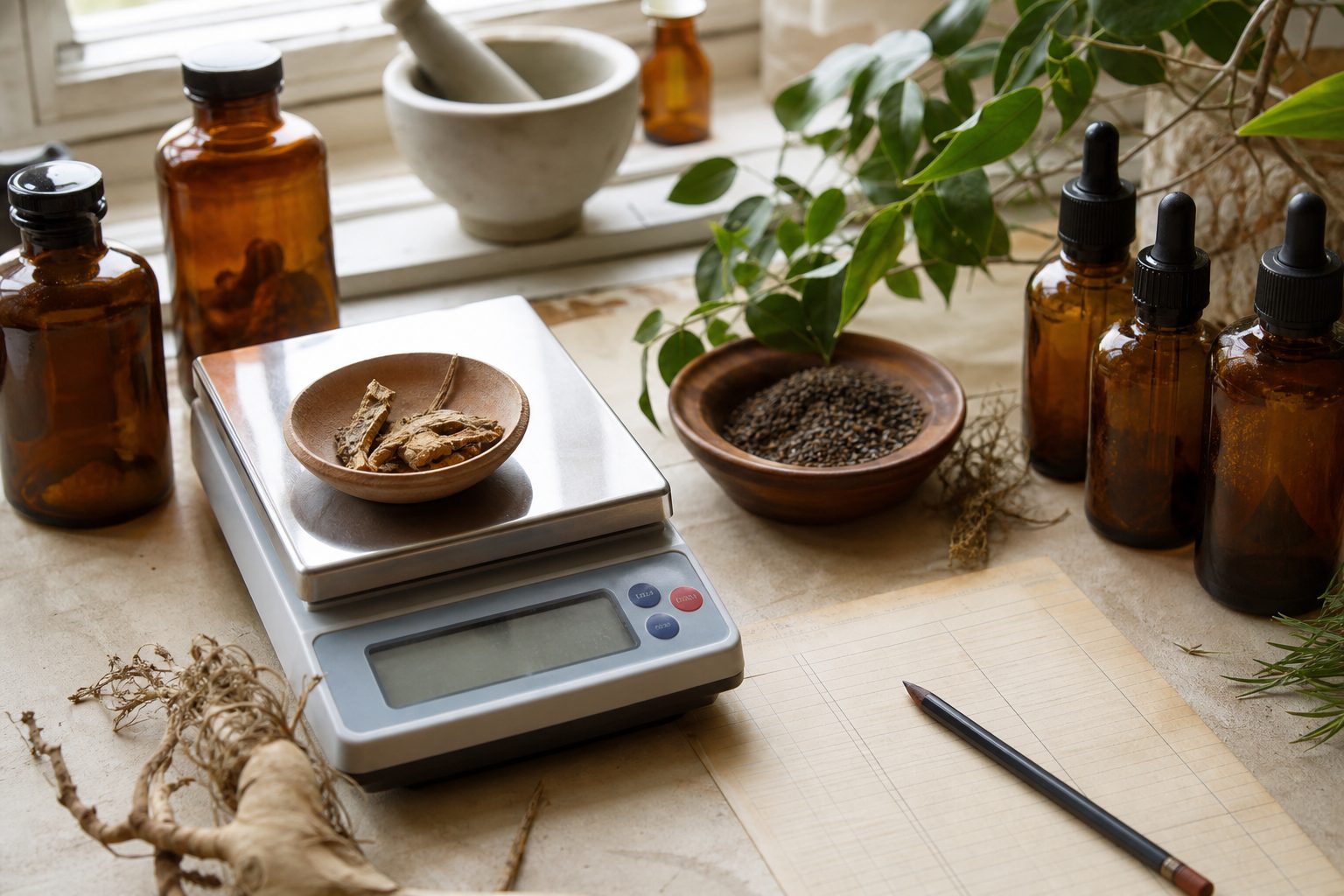
Price the formula, not the bottle. A custom tincture price is built from five stacked lines: the herb cost for the exact grams that went in, the menstruum you extracted with, the packaging that leaves the shop, the consult time that produced the formula, and an overhead rate that pays for the bench being there at all. Add them, then apply a margin. That is the whole method.
The reason this feels harder than it is: you are pricing a thing that changes every time. A client with damp heat and poor sleep gets skullcap, passionflower and a little licorice. The next client gets ashwagandha, milky oat and rhodiola at four times the raw material cost. If both bottles are $28, one of them is a donation.
What follows is a costing method you can run on a ledger card in about six minutes per formula, and a set of decisions about wholesale, retail and price review that keep the method honest when a supplier reprices a lot mid year.
Why a flat price per bottle loses money on custom work
Flat pricing works when inputs are stable. A soap maker running one recipe can price per bar because every bar is the same bar. Custom formulation is the opposite: the variable that moves most, raw herb cost, is exactly the variable a flat price ignores.
Consider two 2 oz formulas at the same retail price. Formula A uses common nervines you buy at $18 to $26 per pound. Formula B leans on a wildcrafted root at $95 per pound plus an organic adaptogen at $60. If your flat price was set against A, B is quietly funded out of your labor.
Worse, the expensive formulas are usually the ones clients reorder. Flat pricing punishes your best sellers. The fix is not a bigger flat number, which prices you out of the simple blends. It is per formula costing.
Keep reading: What does the FDA actually require on the label of a tincture I blend and sell myself?
Costing dried herb by the gram instead of by the pound
Buy by the pound, cost by the gram. A pound is 453.6 grams, so gram cost is simply the delivered price per pound divided by 453.6. Delivered means the invoice price plus the shipping allocated to that item, because freight on bulk botanicals is not a rounding error.
Say you receive 4 lb of tulsi at $24 per pound with $18 of freight spread across a 20 lb order. Freight per pound is $0.90, so delivered cost is $24.90 per pound, which is $0.0549 per gram. Round up to $0.055 and use that.
| Herb | Delivered $/lb | $/gram | Grams in formula | Line cost |
|---|---|---|---|---|
| Tulsi leaf | $24.90 | $0.0549 | 30 | $1.65 |
| Milky oat tops | $38.00 | $0.0838 | 25 | $2.10 |
| Ashwagandha root | $21.50 | $0.0474 | 20 | $0.95 |
| Licorice root | $14.00 | $0.0309 | 5 | $0.15 |
| Herb subtotal | 80 g | $4.85 |
Those per pound figures are illustrative. Use your own invoices. The arithmetic does not change: delivered price divided by 453.6, times grams in the batch, divided by bottles yielded.
If that 80 g of herb went into a batch that filled twelve 2 oz bottles, herb cost per bottle is $4.85 divided by 12, or $0.40. Custom work is often much smaller batches, and that is where per bottle cost climbs fast.
Menstruum, alcohol cost and solvent loss
Alcohol is your second material line and it is rarely costed properly. Organic cane alcohol at 190 proof commonly runs somewhere in the $40 to $70 per gallon range depending on volume and supplier, before federal excise considerations. A gallon is 3,785 mL. At $55 per gallon that is $0.0145 per mL of 190 proof spirit.
You are not selling 190 proof, though. A 1:5 tincture at 50 percent alcohol from 190 proof means you dilute with water. For 400 mL of finished menstruum at 50 percent, you need roughly 400 times 50 divided by 95, which is about 210 mL of the 190 proof spirit, and the balance as water. Spirit cost is 210 times $0.0145, or about $3.05.
Now account for loss. Marc retains liquid. A press leaves you with less than you poured in, and how much less depends on the herb: leafy material holds far more than roots. Assume a 20 percent loss on a hand pressed dried herb tincture unless your own reconciliation says otherwise. That means your 400 mL of menstruum returns about 320 mL of liquid, which fills five 2 oz bottles with a little left over.
So price against yield, not against what you poured. Menstruum cost per bottle here is $3.05 divided by 5, about $0.61. If a hydraulic press reliably recovers 88 percent, update the assumption rather than keeping a comfortable old number.
Packaging, closures, droppers and label cost per unit
Packaging is the easiest line to build accurately and the easiest to underestimate, because it arrives in cases and you stop thinking about it.
- 2 oz amber boston round with dropper assembly: figure your case price divided by count, often in the range of $0.90 to $1.60 per unit at small case volumes.
- Shrink band or tamper seal: a few cents each, but required if you want a credible tamper evident closure.
- Label stock and printing: if you print in house, cost the label as materials plus a realistic share of ink and waste. A sheet that yields eight labels and costs $0.55 with ink is about $0.07 per label, plus the two you ruin.
- Box or bag for handoff, and a printed dosing card if you include one.
Add a waste factor. Assume 5 percent of labels and 2 percent of bottles go to misprints, chips and cracked droppers. Multiply the packaging subtotal by 1.05.
Keep reading: How do I set up lot tracking so I can trace one finished bottle back to its ingredient lots?
Pricing your consultation time separately from the product
Bundle the consult into the bottle and you will end up giving away clinical time to anyone who wants a cheap tincture. Separate them. The consult is a service with its own rate; the tincture is a product with its own margin.
Set a consult rate from the income you need. If you want $55,000 from clinical work and can realistically bill 15 client hours a week for 46 weeks, that is 690 billable hours, so $79.71 per hour. Round to $85 to absorb the notes and formula design you do off the clock. Charge an intake rate for the first 75 minute session and a shorter follow up rate after.
Then, if you want to reward continuity, discount the product rather than the consult: a small standing client price on refills. The discount comes off a line you control, not off your clinical hour.
Building an overhead rate from rent, insurance and bench hours
Overhead is the line most makers skip, and it is the reason a shop with good margins still cannot make payroll. Build it once a year.
Total your annual fixed costs: rent and utilities, product liability insurance, business insurance, software, licenses and permits, accountant, bank and processing fees you cannot allocate, equipment depreciation, and the fraction of your own salary not covered by billable consults. Say that totals $34,000.
Now count bench hours: the hours you actually spend making product, not the hours the shop is open. If you formulate and press 10 hours a week for 46 weeks, that is 460 bench hours. Overhead rate is $34,000 divided by 460, or $73.91 per bench hour.
That number looks alarming until you apply it. A batch of twelve bottles that takes 40 minutes of hands on time carries 0.67 times $73.91, about $49.27, or $4.11 per bottle. Maceration weeks are not bench hours; only your hands on the work counts.
The full worked bottle
| Line | Per 2 oz bottle |
|---|---|
| Herb | $0.97 |
| Menstruum | $0.61 |
| Packaging with waste factor | $1.82 |
| Overhead at $73.91 per bench hour | $4.11 |
| Total cost | $7.51 |
At a 2.5 times markup that bottle retails at $18.78, call it $19. At 3 times it is $22.53, call it $23. Both are defensible. What is not defensible is a $28 flat price you chose because the shop down the road charges $28.
See how HerbalCounter handles this for herbal apothecaries and small batch wellness makers
Setting wholesale versus direct retail on the same formula
Only stock formulas go wholesale. Custom client blends do not: a formula designed for one person is not a shelf product.
For your stock line, work backward from retail. A common structure: wholesale is half of your suggested retail, and your cost should sit at or below half of wholesale. Using the $7.51 bottle, wholesale at $16 and suggested retail at $32 gives the retailer a keystone margin and leaves you $8.49 per unit at wholesale.
If that math does not work, the answer is a larger batch, not a thinner margin. Overhead per bottle is the line that responds to batch size. Doubling a batch rarely doubles the hands on time.
Reviewing prices when a single ingredient lot doubles in cost
Botanical prices move on weather, harvest and export policy. A root that was $28 per pound can be $70 the next season. The discipline is knowing which formulas that touches before the invoice tells you.
Use a simple rule. Recost a formula when any single ingredient's delivered gram cost moves more than 25 percent, or when total herb cost for the formula moves more than 15 percent. Below that, absorb it. Above it, reprice at the next batch, never mid batch.
Three responses when a price spikes:
- Reprice the formula, and tell standing clients before their next refill rather than at pickup.
- Reformulate with a defensible substitute, and record why in the client's formula history so you are not guessing next year.
- Hold the price and accept a thinner margin for a defined period, then review. This is a choice, not a default.
Do a full price review once a year against fresh invoices and a fresh overhead calculation. Between reviews, the 25 percent trigger catches the shocks.
Where the costing lives after you build it
The method above only works if the numbers are somewhere you can find them under pressure. Gram costs by supplier lot, grams used per batch, yield after pressing, and which client formula drew from which lot: that is one connected record, not four notebooks.
HerbalCounter holds client formula records tied to batch logs with ingredient lot traceability, so the delivered gram cost you entered when a shipment arrived is the number that prices the bottle it ends up in, and a reorder prompt tells you the root is running low before the price spike is your problem. Cost the formula once, and let the record do the arithmetic every time after.

Jimenez Julien builds HerbalCounter and spends part of every month behind a working counter with clinical herbalists and apothecary owners, watching how formula cards, batch books and lot tags are actually kept. He writes The Formulation Bench to put the costing, labeling and traceability questions that come up at the bench into plain, usable language.