regulation and compliance
What does the FDA actually require on the label of a tincture I blend and sell myself?
Dietary supplement labeling has five mandatory elements and hard rules about claims. A plain reading of what must appear on your bottle, where it must appear, and what draws a warning letter.
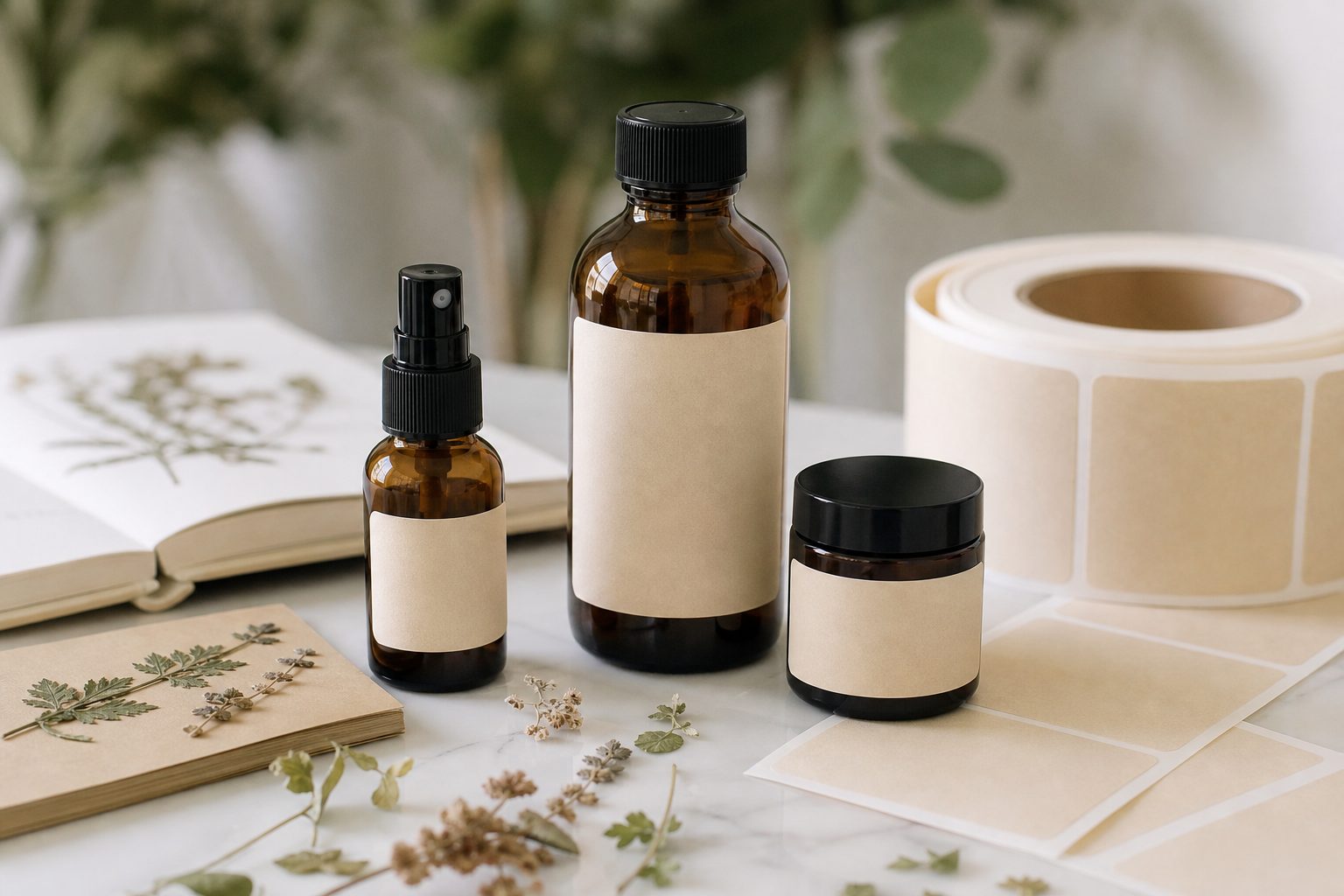
If you sell a tincture as a dietary supplement, federal labeling law requires five things on the container: a statement of identity, the net quantity of contents, a Supplement Facts panel, an ingredient list where one is needed, and the name and place of business of the manufacturer, packer or distributor. Those are set out in the Federal Food, Drug, and Cosmetic Act as amended by DSHEA and in FDA's supplement labeling regulations at 21 CFR Part 101.
Everything else that gets shops into trouble is about what you say rather than what you list. Claims are the enforcement story. A tincture that says "supports a healthy stress response" is a supplement. The same tincture that says "treats anxiety" is, in FDA's reading, an unapproved new drug, and that is what warning letters are built on.
Below is a plain reading of each required element, where it has to sit on the bottle, and the specific places small makers get caught. This is a working summary, not legal advice, and state law can add requirements on top.
Supplement or cosmetic or drug: how intended use decides your rules
Product category is not decided by what is in the bottle. It is decided by intended use, which FDA reads from your labeling, your website, your social posts, your shelf talkers and what your staff says at the counter.
- Dietary supplement: intended for ingestion to supplement the diet, containing a dietary ingredient such as an herb or botanical. Your internal tinctures live here.
- Cosmetic: intended to cleanse, beautify or alter appearance. An infused facial oil sold for skin softness is a cosmetic and follows cosmetic labeling instead, including an ingredient declaration in descending order of predominance.
- Drug: intended to diagnose, cure, mitigate, treat or prevent disease. You do not want to be here. Nothing on your bench has been through a new drug application.
A single product can be pushed across the line by a blog post. The salve you label as a cosmetic becomes a drug the moment your product page says it clears eczema. Audit your own copy the same way you audit your labels.
Keep reading: How do I set up lot tracking so I can trace one finished bottle back to its ingredient lots?
The five required label elements and their placement
Labeling rules split the container into two areas. The principal display panel is the part the customer sees at purchase. The information panel is the panel immediately to the right of it.
| Element | Where it goes | Note |
|---|---|---|
| Statement of identity | Principal display panel | Must include "dietary supplement" or an equivalent such as "herbal supplement" |
| Net quantity of contents | Principal display panel, lower 30 percent | Placed parallel to the base of the container |
| Supplement Facts panel | Information panel | Prescribed format with a heavy bar structure |
| Ingredient statement | Immediately below Supplement Facts | Needed for anything not already declared in the panel |
| Name and place of business | Information panel | Street address may be omitted if listed in a current directory |
On a 1 oz or 2 oz boston round there is not much real estate, which is why small makers use a wrap label or a two panel label with a peel back layer. Shrinking type to make it fit is not an option: the regulations set minimum type sizes, and net quantity type size scales with the area of the display panel.
Supplement Facts versus an ingredient statement for a proprietary blend
The Supplement Facts panel declares serving size, servings per container, and each dietary ingredient with its quantity per serving. For herbs there is no established Daily Value, so those rows carry a symbol footnoted as "Daily Value not established."
A proprietary blend gets special treatment. You may declare the total weight of the blend rather than each ingredient's individual amount, but you must still list every ingredient in the blend by common name, in descending order of predominance by weight, indented under the blend line.
Two things trip people up here. First, the blend name has to be followed by the word "blend" or similar and the total quantity. Second, the exemption covers quantity, not identity. You never get to hide what is in the bottle.
The ingredient statement below the panel is where non dietary ingredients go: your menstruum. Organic cane alcohol and water belong there, along with vegetable glycerin if you used it.
Serving size on a liquid extract
Express the serving in a household measure your customer can actually use, with a metric equivalent. "Serving size: 30 drops (approximately 1.5 mL)" works. Then servings per container has to be consistent with that: a 2 oz bottle is 59 mL, so at 1.5 mL per serving that is about 39 servings. Do the division and print the real number.
Naming the plant part and the Latin binomial
Botanical ingredients require more than a folk name. For each herb, list the common or usual name and, in parentheses or otherwise, the Latin binomial. Where the standard reference name is not itself specific, include the author citation. And critically, you must identify the part of the plant used.
So not "dandelion." Instead: Dandelion root (Taraxacum officinale). Not "elder." Instead: Elder flower (Sambucus nigra) or Elder berry, depending on what actually went in.
Plant part matters clinically and legally. Ashwagandha root and ashwagandha leaf are not the same input, and a label that says only "ashwagandha" fails the requirement and also fails your own traceability. If your batch record names the part, your label can too.
Keep reading: Should I buy bulk herbs from a wholesaler or contract directly with a regional grower?
Structure function claims, the disclaimer and the notification window
A structure function claim describes how an ingredient affects the normal structure or function of the body: supports healthy digestion, helps maintain normal sleep patterns, supports the body's normal inflammatory response. These are permitted on supplements without FDA preapproval, but three conditions attach.
- The claim must be truthful and not misleading, and you must have substantiation for it in hand before you print it.
- The label must carry the disclaimer: "This statement has not been evaluated by the Food and Drug Administration. This product is not intended to diagnose, treat, cure, or prevent any disease." It must be set off with a boxed or otherwise prominent placement and linked to the claim, typically by an asterisk.
- You must notify FDA of the claim no later than 30 days after first marketing the product with it.
That 30 day notification is the step small makers skip most often, usually because nobody told them it existed. It is a submission naming the claim text and the product, and it is a condition of using the claim at all.
Disease claims that turn a supplement into an unapproved drug
A disease claim says or implies the product affects a specific disease or class of diseases. Implication counts. FDA reads the whole label and the whole marketing context.
Things that read as disease claims even without naming a condition:
- Naming a drug class: "a natural alternative to antibiotics."
- Citing a study on treating a disease, on the label or the product page.
- Product names that carry the claim: "Arthri Ease," "Flu Fighter."
- Symptom clusters that only describe a disease state: lowers blood sugar, dissolves stones, kills parasites.
- Images or symbols that imply a disease, including a heart with an EKG line.
Customer testimonials on your site do not get a pass. If a reprinted review says the tincture cured her migraines, that is your claim now, because you published it. The same is true of a repost, a pinned comment, or an influencer's video you share.
See how HerbalCounter handles this for herbal apothecaries and small batch wellness makers
Allergen and alcohol content disclosures
Major food allergens must be declared under FALCPA, and that applies to supplements. The relevant ones for herbal work are usually tree nuts in carrier oils, sesame, soy in some lecithins and glycerin sources, milk in a few flavorings, and wheat if you use a wheat derived ingredient. Declare with a "Contains" statement or in the ingredient list in the required form.
Alcohol content is not an FDA mandated percentage disclosure on supplements the way it is on beverage alcohol, but declaring it is standard practice, expected by customers and pharmacists, and useful for anyone avoiding alcohol. State a percentage such as "Alcohol content: 45 to 55 percent by volume" and make sure your process supports the range you print.
If you make a glycerite specifically so it is alcohol free, say so plainly, and be sure it truly is: a tincture used as an intermediate carries alcohol forward.
Net quantity, lot code and your name and address of record
Net quantity of contents appears in both US customary and metric units. For a liquid, that is fluid ounces with the milliliter equivalent: "Net 2 fl oz (59 mL)." It sits in the lower 30 percent of the principal display panel, parallel to the base.
The name and place of business must identify the manufacturer, packer or distributor. If you are not the manufacturer, the line must say so, for example "Distributed by." Your own shop making its own tinctures just gives the business name and address.
Lot code deserves its own note. FDA's dietary supplement current good manufacturing practice rule at 21 CFR Part 111 requires batch and lot identification in your records, and a code on the finished package is how you connect a bottle in a customer's hand to the batch record on your bench. Put it on the label, and make it something a person can read aloud over the phone.
Getting the label and the batch record to agree
Nearly every labeling failure on a small bench is really a records failure. The plant part is missing on the label because it was missing on the receiving log. The serving count is wrong because nobody measured the actual fill. The lot code is a sticker applied later, disconnected from the batch it came from.
HerbalCounter ties each finished bottle's lot code back through the batch log to the ingredient lots that fed it, with the Latin binomial and plant part carried from receiving through to the label. When an inspector or a customer asks what went into a specific bottle, the answer is one lookup, and the label is printing from the same record that made the batch.

Jimenez Julien builds HerbalCounter and spends part of every month behind a working counter with clinical herbalists and apothecary owners, watching how formula cards, batch books and lot tags are actually kept. He writes The Formulation Bench to put the costing, labeling and traceability questions that come up at the bench into plain, usable language.