mistakes to avoid
What are the most common mistakes herbalists make when scaling a formula from one quart to five gallons?
Bigger batches are not multiplication. Ratio drift, poor maceration, heat load, filtration loss and record gaps are the failures that turn a proven formula into an inconsistent one.
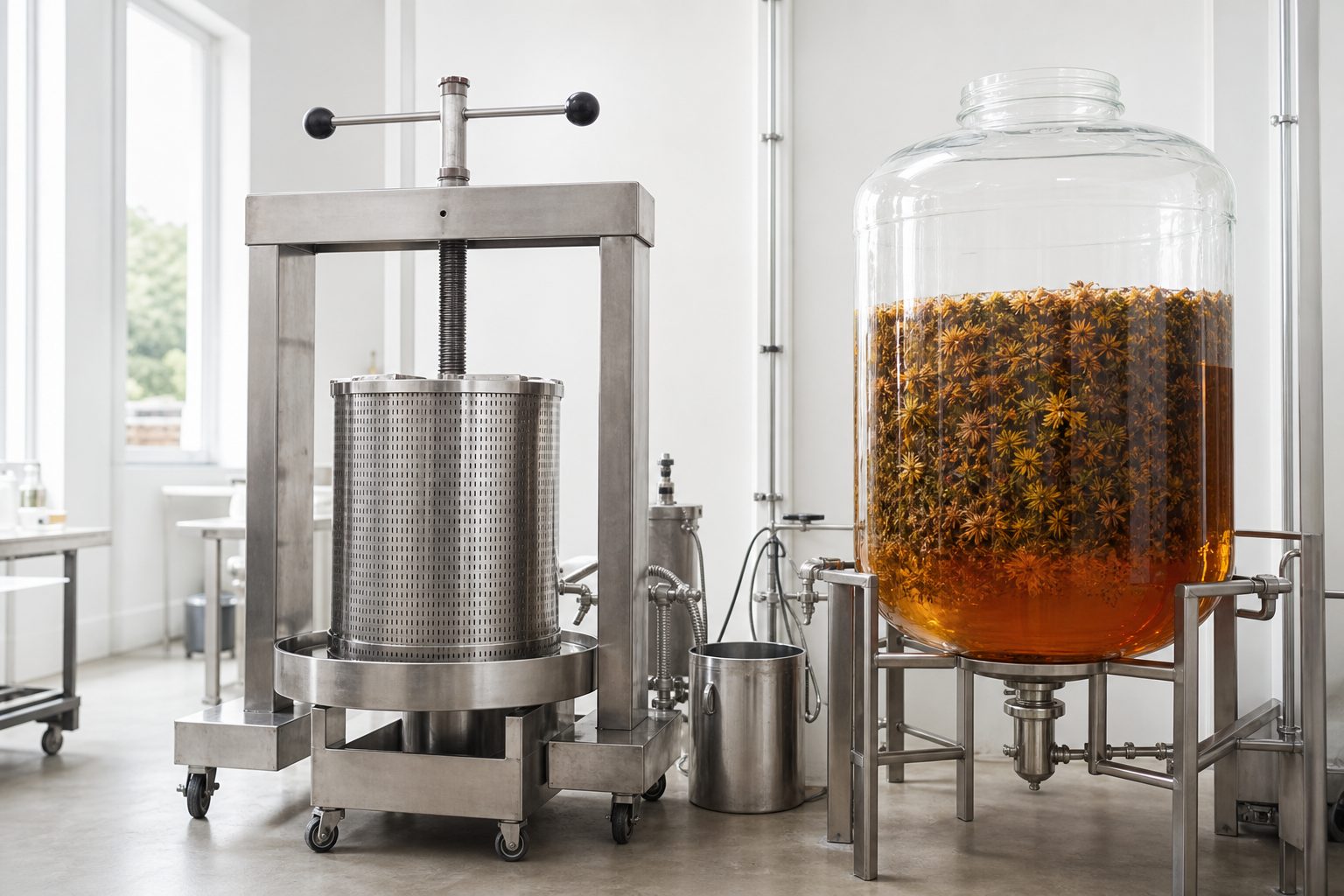
The short answer: the failures are almost never in the herbs. They are in the assumption that a proven quart formula is a five gallon formula with the numbers multiplied by twenty. It is not. Absorption into the marc, vessel geometry, solvent loss, filtration and the order in which you write things down all behave differently at volume, and each one moves your finished product away from the thing your clients already trust.
The five that account for most ruined scale ups, in rough order of how often they bite: underestimating how much menstruum the plant material keeps, letting the alcohol percentage drift during a longer maceration, poor agitation in a tall narrow vessel, filtration losses nobody budgeted for, and changing the herb supplier in the same batch that changed the size.
What follows is what each failure looks like on the bench, and how to catch it before the batch is on a shelf with a label on it.
Treating weight to volume ratio as linear when it is not
A 1:5 tincture means one part herb by weight to five parts menstruum by volume, and that ratio does scale cleanly on paper. What does not scale is the relationship between that ratio and what comes out of the press.
At a quart, you are working with roughly 100 grams of dried herb in about 500 mL of menstruum. At five gallons you are at about 3.8 kilograms of herb in nearly 19 liters. The input ratio is identical. The recovered volume is not, because losses that were a rounding error at quart scale become a line item.
Two habits fix this. State the master formula by weight where you can, including the menstruum, so a scale up is arithmetic and not judgment. And distinguish in your records between the ratio you charged and the yield you recovered. They are different numbers and only one belongs on the label.
Keep reading: How did one small apothecary move from farmers market sales to a licensed production space?
Underestimating marc absorption and press yield
This is the big one. Spent plant material holds menstruum, and how much it holds depends on the plant part far more than on your equipment.
A reasonable planning assumption, and it is an assumption you should verify against your own presses rather than take from an article: dried leaf and flower retain in the range of three to four times their dry weight in liquid after pressing, roots and barks somewhat less, and light fluffy aerials more.
Work it at 1:5 with dried leaf and a planning figure of 3.5 times dry weight retained:
- Herb charged: 3,800 g. Menstruum charged: 19,000 mL.
- Retained in marc after pressing: 3,800 x 3.5 = 13,300 mL.
- Recovered: 19,000 minus 13,300 = 5,700 mL, about 1.5 gallons.
That is a shock the first time you see it, and it is why the quart bench trial felt fine and the five gallon batch felt like a loss. The quart batch lost the same proportion. You just did not notice 350 mL sitting in a cheesecloth bundle the way you notice three gallons of wet marc.
The response is not to charge less menstruum. It is to know the number before you buy the herbs, so cost per finished ounce is real and the order quantity is right. Record recovered volume on every batch. After four or five batches of the same herb you have your own retention factor, worth more than any published range.
Vessel geometry, headspace and inadequate agitation
A quart jar gets shaken. You pick it up, you invert it, every particle moves. A five gallon carboy or a 20 liter stainless vessel does not get shaken, it gets stirred, and stirring a packed bed of hydrated herb is a different physical problem.
Dried herb swells. Leaf material that occupied a third of the vessel dry can occupy most of it wet, and it will compact into a plug at the bottom or float as a cap at the top depending on the plant. Either way, menstruum stops circulating through the middle of the mass and you get partial extraction in a batch you believe is fully macerated.
Practical countermeasures:
- Choose a wider vessel over a taller one at the same volume. Bed depth is what defeats circulation.
- Leave real headspace, roughly ten to fifteen percent, so material has room to move when you stir.
- Stir on a schedule that is written into the batch record, not when you remember. Daily for the first week is a defensible practice.
- Stir from the bottom up with a long paddle, breaking the plug, and use a follower or weighted screen on herbs that float.
Solvent evaporation and alcohol percentage drift
Ethanol evaporates faster than water. A quart jar with a tight lid, opened once a day, loses very little. A large vessel that is opened for stirring, has a larger liquid surface, and sits for two weeks in a warm room can lose enough ethanol to move the finished percentage down measurably.
That matters in two ways. Lower alcohol changes what you are extracting, particularly for resinous and volatile constituents. And the alcohol percentage on your label is a statement about the product, so it needs to reflect what is in the bottle.
Control it with boring measures. Keep the vessel sealed between stirs, stir quickly, keep the room cool and out of direct sun. Do not macerate in an open crock with a cloth over it and then declare a percentage from your starting calculation. If percentage is a specification you hold, verify the finished batch rather than compute it, and record which method you used.
Keep reading: What should be on my checklist before I release a finished batch of salve to the shelf?
Filtration bottlenecks and clarity problems
Filtration is where a scale up eats a workday. A quart passes through a coffee filter or a fine mesh in a few minutes. Five gallons through the same media clogs, and then you are standing there at nine at night changing filters while the extract oxidizes in an open container.
Plan filtration as a two stage operation. First a coarse strain to remove the bulk of the fines, mesh or a filter bag. Then a finer polish through pads or a plate filter, sized so the whole batch passes in one setup without changing media midway. Mucilaginous herbs such as marshmallow and slippery elm, and resinous ones such as myrrh and propolis, will defeat a fine filter no matter how well you plan, so decide in advance whether that product ships slightly cloudy and say so in the specification.
Cold settling helps. Let the pressed liquid rest cold for several days, then rack the clear portion off the sediment before filtering. You will pass a fraction of the solids and lose far less product to a saturated pad.
Changing two variables in the same batch
Scale up is itself a variable. It is the only one you should be changing.
The classic version of this mistake: the shop scales from a quart to five gallons and, because they are now buying 25 pounds instead of one, they also switch to a new supplier at a better price. The batch is different. Nobody can say whether that is the new farm's material, the new vessel, the longer maceration, or all three interacting.
So hold the herb lot constant across the scale up if you can buy enough of one lot. Hold the menstruum, the maceration time and the press unchanged. Change size, and only size. Then next batch, change the supplier and hold size. It is slower by one batch and it leaves you with an answer instead of a theory.
See how HerbalCounter handles this for herbal apothecaries and small batch wellness makers
Writing the master formula only after the batch is done
The master formula is written before, not after. Written after, it is a description of what happened, and a description cannot be repeated by anyone but the person who was in the room.
A workable master formula for a two person shop contains at least:
| Element | What it must state |
|---|---|
| Identity | Product name, formula version number, date effective, who approved it |
| Ingredients | Each herb by botanical name and plant part, weight, and the menstruum by weight and target percentage |
| Theoretical yield | Expected recovered volume with the retention assumption stated, and the acceptable range |
| Process | Grind size, order of addition, vessel, maceration days, stir schedule, press, filtration stages |
| Controls | What is checked, at which step, and what result is acceptable |
| Labeling | Ratio, alcohol percentage, net contents, and the lot numbering rule |
The batch record is the companion document: the same steps with blank spaces for actual weights, actual lot numbers, actual yield, initials and dates. If your yield falls outside the range in the master formula, that is a deviation, and a deviation gets investigated and written down before the product moves.
Manufacturers of dietary supplements under 21 CFR Part 111 are required to have master manufacturing records and batch production records, so this is not merely good practice. Even outside that rule, it is the difference between a formula that belongs to the business and one that lives in one person's hands.
Validating the scaled batch before you sell it
Before the first scaled batch goes to clients, run it against the quart batch you already trust. Keep both, and compare:
- Recovered yield against the theoretical yield in the master formula.
- Color and clarity side by side in identical clear vials against a white card.
- Aroma and taste, blind if you can get a second person to pour.
- Specific gravity, which is quick, repeatable and a decent early warning that something moved.
- Sediment after two weeks standing at room temperature.
Write the comparison down and keep a retained sample of both, labeled with lot and date, somewhere cool and dark. When a client says the new bottle is different, you want a reference sample rather than a memory.
Where this gets easier
All of it depends on the record holding together: this batch, from these lots, at this yield, filling these client formulas. That is exactly what HerbalCounter keeps in one place, so a master formula, its batch log and the ingredient lots behind it stay connected as you scale. Set up your master formula and expected yield range first, record the actual on every batch, and by the fourth run you will be scaling from your own data instead of someone else's rule of thumb.

Jimenez Julien builds HerbalCounter and spends part of every month behind a working counter with clinical herbalists and apothecary owners, watching how formula cards, batch books and lot tags are actually kept. He writes The Formulation Bench to put the costing, labeling and traceability questions that come up at the bench into plain, usable language.