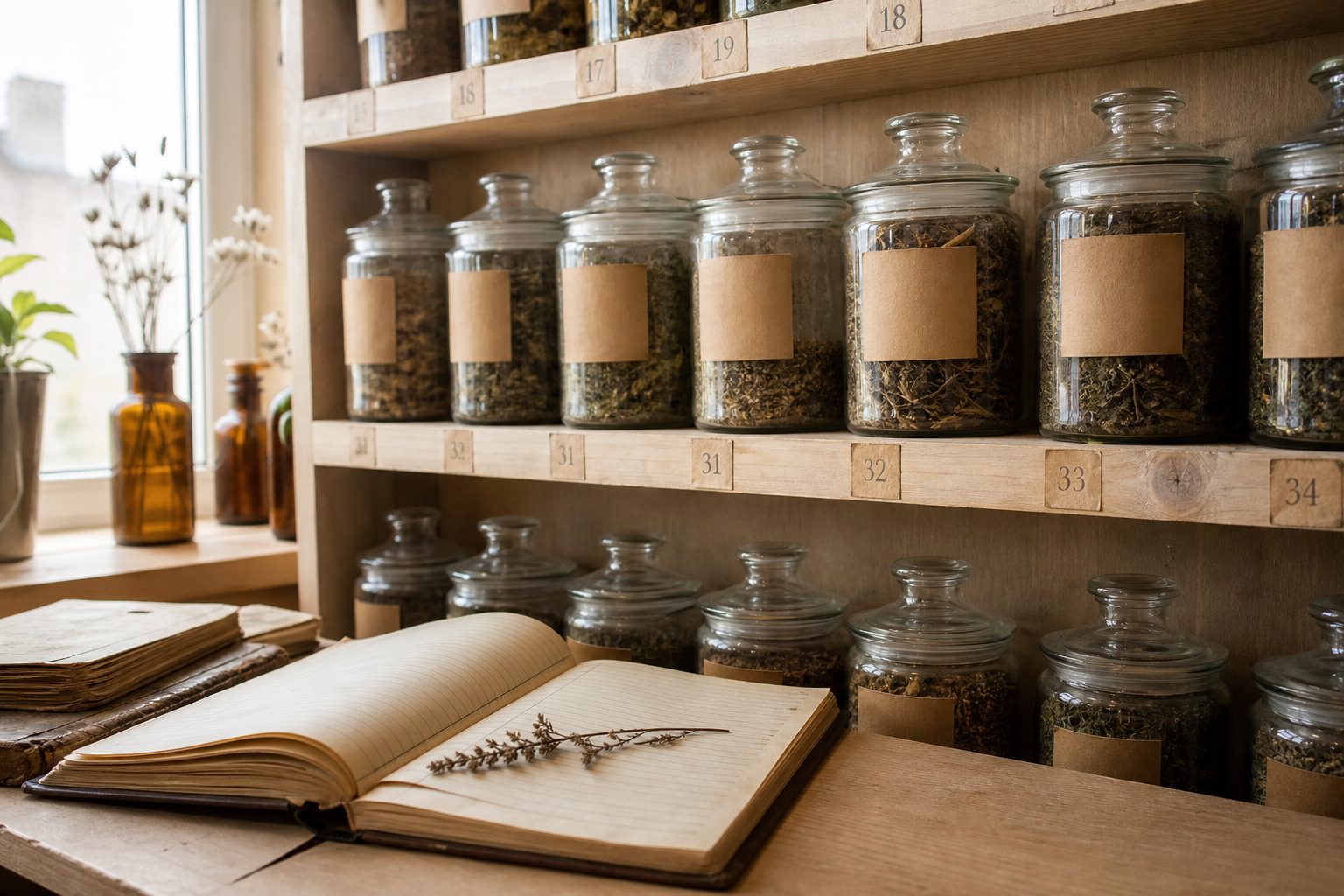
Every blend you hand across the counter can be traced back to the jar it came from
HerbalCounter holds your client formula records, your batch logs and your ingredient lots in one connected file, so a question about a tincture made fourteen months ago takes a minute instead of an afternoon. It was built with practicing herbalists, not adapted from a restaurant inventory app.
318US apothecaries and clinical practices keeping records here
1.4MIngredient lots logged and linked to finished batches
One afternoonTypical time to move a shelf of paper formula cards across
Working counter, not a demo set
What the paperwork actually costs
The formula card system worked at forty clients. It stopped working at three hundred.
You know the moment. A client calls about the sleep blend that worked, the one from last winter, and you are standing at the shelf with a box of index cards, a batch notebook and three supplier invoices, trying to reconstruct what went into it.
Reformulating from memory
When the card is missing a ratio or the menstruum strength, you rebuild the blend by taste and by guess. The client notices that it is not quite the same, and some of them do not come back.
About 6 hours a month rebuilding formulas that were already written down once
Lots you cannot follow
A supplier sends a recall notice on a lot of skullcap. You know you bought it. You do not know which macerations it went into, or which clients carried those bottles home.
A single untraceable lot can force you to pull an entire shelf
Herbs found too late
Half a pound of elderflower quietly reaches the end of its shelf life at the back of the storage room while you order more of it, because nothing told you it was there.
$180 to $400 a year in botanicals written off in a one person practice
Records only you can read
Your notation makes sense to you and to nobody else. The moment you take a week off, your assistant cannot fill a repeat order without calling you at home.
Repeat orders stall for 2 to 4 days whenever you are away from the shop
How the record works
Four things happen at the counter. HerbalCounter records all four in one line.
Write the formula once, keep it living
Enter the client, the constitution notes and the formula itself: herb, part, form, ratio, menstruum, dose. Every later revision is stacked under the same record, so you can see how the blend changed across four consultations without losing the original.
Receive lots as they come off the truck
Log each incoming ingredient with supplier, lot number, harvest or origin, certificate of analysis and the date it landed on your shelf. Scan or type it in, whichever is faster with your hands full.
Make a batch and pull from the shelf
Start a batch from an existing formula. HerbalCounter shows you the open lots for each herb, subtracts what you draw, and writes the lot numbers into the batch record automatically. Yield, press date and finish date go in the same place.
Label, hand it over, and keep the thread
Print the label with your batch code, and the record now runs both directions: from a client bottle back to every lot in it, or from a supplier lot forward to every bottle it touched. When stock falls under your par level, a reorder prompt lands in your morning list.
Built for the bench
Six parts of the system you will use in your first week
Nothing here is borrowed from a generic inventory product. Each piece exists because a herbalist described the exact moment it was missing.
Client formula records
One record per client holds intake notes, constitution, contraindications, current formula and every past revision with the date it changed. You can open a record mid consultation and read it out loud without hunting for the right card.
Batch logs with real yields
Each batch carries its formula, the lots drawn, the maceration window, the press date, the finished volume and the bottle count. Compare the yield of this year's calendula oil against the last three runs without opening a spreadsheet.
Ingredient lot traceability
Every lot gets a number, a supplier, an origin, a receipt date and a certificate of analysis if you have one. Ask which client bottles contain lot number 4417 and the answer comes back in a list you can act on, not a memory exercise.
Par levels and reorder prompts
Set a par level per herb in the unit you actually buy: ounces, pounds or liters. When a batch draws you under it, HerbalCounter puts the herb on a reorder list grouped by supplier, with your last unit price beside it.
Labels that match the log
Print client labels and shelf labels straight from the batch, carrying the botanical names, the batch code, the made on date and the best by date. Because the label is generated from the record, the two can never drift apart.
Recall and inspection packets
Pull a dated packet for one lot or one product: the batch records, the lot documents, the quantities and the distribution. It is the file a state inspector or a wholesale buyer asks for, exported as a PDF in a couple of clicks.
What changes on the floor
Numbers our shops report after two full seasons
These come from anonymized usage data and from quarterly calls with owners running between one and nine thousand bottles a year.
4 min
To answer a traceability question
Search a lot number and you get every batch it entered and every client who received one of those bottles. Practices that used paper batch books reported the same lookup taking three to five hours across notebooks and invoices.
31%
Less botanical waste in year one
Par levels and expiration windows surface the herbs you already own before you reorder them. Shops that used to write off aging stock twice a year now move it into batches while it is still at full potency.
$2,600
Recovered per year at a two person shop
That figure is the sum of the botanicals no longer discarded, the repeat orders that no longer stall while an owner is away, and the consultation hours no longer spent rebuilding formulas that were already recorded once.
From the counter
Three owners on what the record changed for them
I ran a clinical practice on index cards for nineteen years and I was not going to give that up for something built for coffee shops. What sold me was the batch screen: it shows the open lots the way I lay them out on the bench. My assistant filled a repeat tincture order in March while I was in Oregon, and she got it exactly right without a single phone call.
A supplier flagged a lot of chamomile in February. I pulled the affected batches in about four minutes and called the eleven clients who had bottles from them the same afternoon. Two years ago that would have been a weekend of reading my own handwriting, and I would still not have been certain I had found all of them.
We started selling to four co ops last year and every one of them wanted lot documentation before they would put us on a shelf. I used to dread those requests. Now I export the packet from the batch and send it before the buyer has finished the email. It made us look like a company three times our size, which is the point.
96%of shops still logging batches after twelve months
27,400client formula records kept current across the network
Under 3 hrsaverage time to migrate a paper card box with our help
Plans
Priced by the size of your bench, not by seat count
Every plan carries the full formula record, batch log and lot traceability. The tiers differ in how many people work in the system and how much wholesale paperwork you need out of it.
Solo Practice
$35 per month
One clinical herbalist, consultations and custom blends made to order.
Unlimited client formula records with full revision history
Batch logs with lot linking and yield tracking
Ingredient lot register with supplier and origin fields
Every plan is billed monthly in US dollars and can be cancelled at any time from your account settings. There is no annual contract, no setup fee, and your records stay exportable as CSV and PDF for as long as your account is open.
Questions we get on the first call
Straight answers before you spend an hour on a demo
Solo Practice is $35 per month, Shop is $79 per month, and Shop and Wholesale is $159 per month, all in US dollars. The price is fixed by tier, so adding staff accounts inside your tier does not change the invoice. If you outgrow a tier we tell you before we move you, and the change takes effect on your next billing date. Nothing is priced per client record or per batch, because charging you for keeping good records would be backwards.
Most single herbalists are working live the same afternoon they start. You enter your herb list and your suppliers first, then your open lots, then your active client formulas, and the historical cards can follow at your own pace. On the Shop and Shop and Wholesale plans we do the bulk import for you from a spreadsheet or from photographs of your card box. A typical paper migration for a three hundred client practice takes us under three hours.
Your records belong to you and are visible only to the accounts you create. Data is encrypted in transit and at rest, hosted in the United States, and backed up nightly with a thirty day retention window. Our staff do not open your records unless you ask us to look at a specific problem, and every such access is logged and shown to you. We do not sell, rent or analyze your formulas for any purpose of our own.
HerbalCounter connects to Square and Shopify for retail sales, so a bottle sold at the register draws down the batch it came from. Purchase and batch cost data export to QuickBooks Online and to Xero on a schedule you set. Everything else moves through CSV export and a documented REST API with your own key. We deliberately do not try to be your register or your bookkeeper, because the tools you already trust do that better.
You cancel from your account settings and the plan runs to the end of the month you have already paid for. Before or after that, you can export every client formula, batch log, lot record and document as CSV files plus a PDF archive of your batch books. We keep your data for sixty days after cancellation so you can reopen if you change your mind, then delete it permanently. There is no exit fee and no call required to leave.
Many clinical herbalists compound for their own clients and sit outside the dietary supplement manufacturing rules, and that is a real distinction. The traceability still earns its keep for two reasons. The first is the recall phone call, which does not care how you are classified: you need to know who has the bottle. The second is growth, because the day a co op or a clinic asks to stock you, the documentation they require is the documentation you have already been keeping without extra work.
Inside one batch record
What a finished record holds, in the language you already use
This is the shape of a real entry for a spring nettle and horsetail infusion, written the way a herbalist writes it rather than the way a warehouse system wants it.
The formula head
Client initials or the product name, the intent, the form, the total volume, the menstruum and ratio, the dose instruction, and the practitioner who signed off on the blend.
Written once, revised in place, never retyped
The ingredient lines
Each herb with its botanical name, plant part, weight drawn, and the exact lot pulled from the shelf with its supplier and receipt date sitting right beside it.
Every line carries the lot that answers the recall question
The production tail
Start date, maceration window, press or strain date, finished yield, bottle count, batch code, best by date, and any bench note you left for the next person who makes it.
The batch code on the label points straight back to this page
The Formulation Bench
Reporting from the bench, for the people who work one
Practical reporting for clinical herbalists and apothecary owners on formulation, batch records, sourcing, labeling law and shop economics.
Custom blends break flat pricing. Here is how to build a per formula price from menstruum cost, herb cost per gram, bottle and label, consult time and a batch overhead line that actually covers the bench.
Dietary supplement labeling has five mandatory elements and hard rules about claims. A plain reading of what must appear on your bottle, where it must appear, and what draws a warning letter.
Traceability is a numbering habit, not software magic. A step by step method for assigning lot codes to incoming herbs, linking them to batch records, and pulling a full trace in minutes.
Bring your messiest formula card and we will put it in the system on the call
We do not run a scripted demo. Tell us how you work now, whether that is a card box, a spiral notebook or a spreadsheet with fourteen tabs, and we will show you the same information living inside HerbalCounter before the call ends.
An answer comes back within one business day, and your address never gets folded into a mailing list. If you would rather skip the form, send your batch and formula questions straight to jimenezjulien42@gmail.com.
Written and maintained by Jimenez Julien, who builds and runs HerbalCounter and spends part of every month behind a real counter with the herbalists who use it. Read about the author and how this product is built.