comparison
Should I buy bulk herbs from a wholesaler or contract directly with a regional grower?
Two sourcing models with different economics. Minimum orders, price per pound, consistency, testing burden and lead time compared for a shop buying in tens of pounds rather than tons.
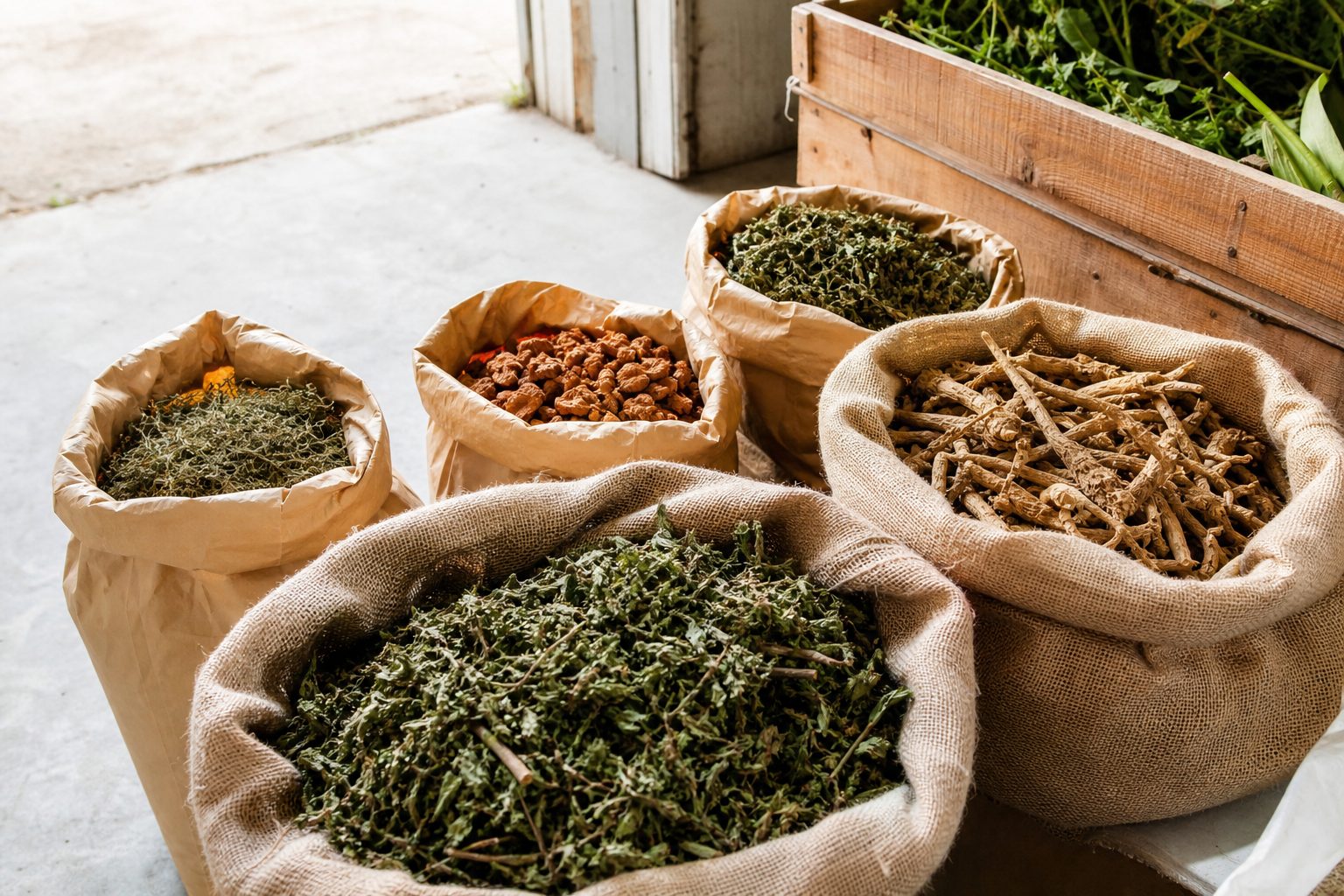
For most shops the honest answer is both, split deliberately rather than by accident. A wholesaler is the right home for the herbs you buy in small amounts, the ones you cannot predict, and the ones where a certificate of analysis in the box saves you a testing bill. A regional grower is the right home for the three or four herbs you buy in real volume, where freshness shows in the finished tincture and where a season of committed purchasing buys you priority.
The mistake is choosing on price per pound alone. Farm direct often looks cheaper on the invoice and costs more once you count freight, identity testing, drying variability and the cash you tied up in a crop that has to be bought at harvest or not at all. Wholesale often looks expensive and quietly absorbs risk you would otherwise be carrying yourself.
Here is how the two models actually differ for a shop buying in tens of pounds a year rather than tons.
Order minimums and what they do to your cash position
Most herb wholesalers serving the trade will sell you a pound, and many will sell a quarter pound at a step up in price. Price breaks usually appear at 1 pound, 5 pounds, 25 pounds and 55 pounds, which is the standard bulk case. That structure lets you buy close to consumption. If you use six pounds of nettle a year, you buy five now and one in the spring.
A grower cannot work that way. A farm dries a crop once, and once it is dried they need it sold and out of storage. The realistic minimum from a small regional producer is the amount they can justify packing and shipping, often 10 to 25 pounds per herb, and the realistic purchase window is the eight weeks after harvest.
Run it out. Say tulsi runs $18 a pound wholesale in a 5 pound bag and $12 a pound from a grower who wants a 25 pound commitment. Wholesale, three purchases of 5 pounds across the year ties up $90 at a time. Farm direct ties up $300 in September and keeps it tied up until the material is in bottles. On a shop with $4,000 of working capital that is a real share of the account for one herb, and you may have made the same decision for four others.
Keep reading: What are the most common mistakes herbalists make when scaling a formula from one quart to five gallons?
Price per pound against freight and shrink
Landed cost is what matters: invoice price per pound, plus freight divided across the actual weight in the shipment, plus moisture and cleaning loss, plus storage, plus any test cost you carry yourself.
Dried leaf is bulky and light, which is exactly the profile freight carriers punish. Twenty five pounds of dried peppermint is a dimensional weight problem, and a small farm shipping it in a single oversized box can generate $60 to $90 in freight in a way that a wholesaler consolidating a pallet route does not. That is $2.40 to $3.60 a pound added to a $12 herb, and the gap to a $18 wholesale price narrows fast.
Roots and barks are denser and travel better, so farm direct economics are usually stronger for burdock, elecampane and marshmallow than for delicate aerial parts. Shrink runs the other way: farm dried material that came off a rack last month is less brittle and less dusty than a lot that sat in a warehouse for a year.
Identity testing: who does it and who pays
If you make dietary supplements, 21 CFR Part 111 requires you to verify the identity of each incoming component lot. That obligation belongs to you, the manufacturer, no matter who grew the plant. You cannot outsource it to a supplier's word.
What differs is how much work is left for you. An established wholesaler serving supplement manufacturers will usually supply an identity result with the lot: organoleptic evaluation, macroscopic and microscopic examination, sometimes TLC or HPTLC fingerprinting against a reference. You are still responsible for a qualification decision, but you are reviewing documentation rather than generating it.
A regional farm almost never has that infrastructure. They know the plant is what it is because they planted it, which is a real form of evidence and not a document. If you buy farm direct, plan to do your own organoleptic and macroscopic identity work against an authoritative reference such as a published monograph, keep a retained sample of every lot, and budget for outside lab work on the herbs where adulteration or misidentification is a known problem.
Where outside testing earns its cost
Spend the lab money where substitution history is real, not evenly across the shelf: skullcap and its history of germander substitution, bulk root material where whole plant characteristics are gone, and anything bought as powder rather than cut and sifted, because powder destroys the macroscopic evidence you would otherwise use.
Certificates of analysis and what a broker can and cannot tell you
A certificate of analysis is a lot specific document. It should name the lot, the test methods and the results. If the document you were sent has no lot number on it, or the lot number does not match the number on the bag in your hand, it is a marketing sheet.
A good wholesale certificate typically covers identity method and result, moisture, heavy metals, microbial counts, and often pesticide screening. It usually does not cover the growing conditions or harvest date behind the lot. A broker sits between you and the farm and often genuinely does not know. That is structure, not deception. If provenance matters to your formulas, a broker cannot give it to you and a grower can.
Keep reading: How did one small apothecary move from farmers market sales to a licensed production space?
Harvest windows, crop failure and single source risk
A farm has one shot a year at each crop. Hail in June, a wet drying week in August, an early frost, a labor gap at harvest: any of these can mean the herb you committed to does not exist. You will find out in September, and by then the wholesale market has often already moved.
Wholesalers pool that risk across many growers and regions, which is what the margin buys. So: never let a formula that carries real revenue depend on a single farm with no qualified backup. Qualify a second supplier before you need one, buy at least one small lot from them so the qualification is real rather than theoretical, and keep that record.
Organic and wildcraft certification down the chain
Organic claims under the USDA National Organic Program follow the whole chain. If you want to call a finished tincture organic, or list organic ingredients, the growers must be certified and you generally need to be certified as a handler yourself unless you qualify for the small handler exemption based on annual organic sales. Buying certified material does not by itself let you make a certified claim on your label.
Wildcrafted is a different situation, because it is not a regulated term at all. If a supplier says wildcrafted, the only meaningful follow up questions are where, under what harvest permission, and how much of the stand was taken. Ask about at risk species specifically. Goldenseal, American ginseng, black cohosh, false unicorn and slippery elm all carry conservation status concerns, and a supplier who cannot describe their harvest practice for those plants should not be selling them to you.
See how HerbalCounter handles this for herbal apothecaries and small batch wellness makers
Building a split sourcing plan for your top ten herbs
Pull your last twelve months of purchases and rank herbs by dollars spent, not by number of orders. Then sort each into a lane using this rule:
| Condition | Lane | Why |
|---|---|---|
| Over 20 pounds a year, dense material, freshness affects the finished product | Farm direct, primary | Volume clears the minimum, freight per pound is tolerable, quality gain is visible |
| Over 20 pounds a year, light aerial parts | Farm direct if in your region, wholesale if not | Freight can erase the savings on long hauls |
| Under 5 pounds a year | Wholesale | Minimums exceed annual use, material ages out before you finish it |
| Bought as powder | Wholesale | Identity verification is harder and more expensive on your side |
| Carries a formula that is more than 10 percent of revenue | Two qualified suppliers, always | Crop failure cannot be allowed to stop a core product |
| Certified organic claim on the finished label | Whichever supplier holds a current certificate for that crop | The claim depends on the chain, not the price |
Most shops find seven of the top ten stay wholesale and three move to a farm. That is a good outcome. The point is that each one moved for a stated reason you can find again next year.
Questions to ask a grower before the first season
Ask these before you commit money, and write the answers down next to the supplier record:
- Which crops do you grow, on how many acres, and what did you actually harvest last year?
- How do you dry, at what temperature, and how do you know when it is done?
- How do you assign lot numbers, and will that number appear on the bag and the invoice?
- What is your harvest window for each crop, and when do you need my commitment?
- Do you hold organic certification, and does the certificate list this crop?
- If the crop fails, what happens to my deposit?
- Will you sell me a small trial lot this year before I commit next year?
That last one separates a workable relationship from a gamble. Buy five pounds, run it through a real batch, compare the finished tincture against your wholesale control, and decide from evidence.
Making the decision hold up next year
Whichever way you split it, the sourcing plan only pays off if the lot detail survives the trip from the receiving bench to the finished bottle. When a farm lot underperforms, or a grower asks what you thought of the September cutting, or a client reacts to a batch, you need to walk backward from the bottle to the bag without reconstructing anything from memory.
That is what HerbalCounter is built to hold: ingredient lots recorded with supplier, certificate and receiving notes, tied to the batches that used them and to the client formulas those batches filled. Set your top ten herbs up as tracked ingredients, record each incoming lot as it lands, and by next harvest you will have a year of real evidence about which lane each herb belongs in.

Jimenez Julien builds HerbalCounter and spends part of every month behind a working counter with clinical herbalists and apothecary owners, watching how formula cards, batch books and lot tags are actually kept. He writes The Formulation Bench to put the costing, labeling and traceability questions that come up at the bench into plain, usable language.